Yesterday I had the opportunity to speak to Canadian Black Book’s Talk Auto 2026. It was a fabulous event that was full of insights into the state of the Canadian auto market. Kudos to Canadian Black Book for making this happen. Particularly with the possibility for chaos in 2027, I recommend marking your calendar now to attend next year’s event.
In the meantime, here is my Talk Auto presentation from yesterday…

Welcome to November 5, 2026
We are now 56 days away from New Years Eve.
A date that has particular importance this year as it originally marked the end of Canada’s canola export agreement with China (you know the one that was negotiated along with the quota on Chinese cars) and, when the clock changes, we face the prospect of Donald Trump’s 50% tariffs on Canadian cars. Yesterday, the canola agreement was extended by two years but it will still have an impact on cars by the end of December. And of course the new Democratic majority will take hold of the House and Senate just a few days later.
There is a quote, widely but wrongly attributed to Vladimir Lenin, that goes: There are decades when nothing happens and there are weeks where decades happen. We are experiencing some of those weeks.
Curiously, a buoyant retail market, positive sounding words from our trade negotiators over the last few days and the results of the US midterms have people thinking that we are back on track to a trade deal. This leads some people to believe that all of the industry’s problems will go away well in advance of the deadline. Maybe, but if you are in that camp I think you are also overlooking some important details.
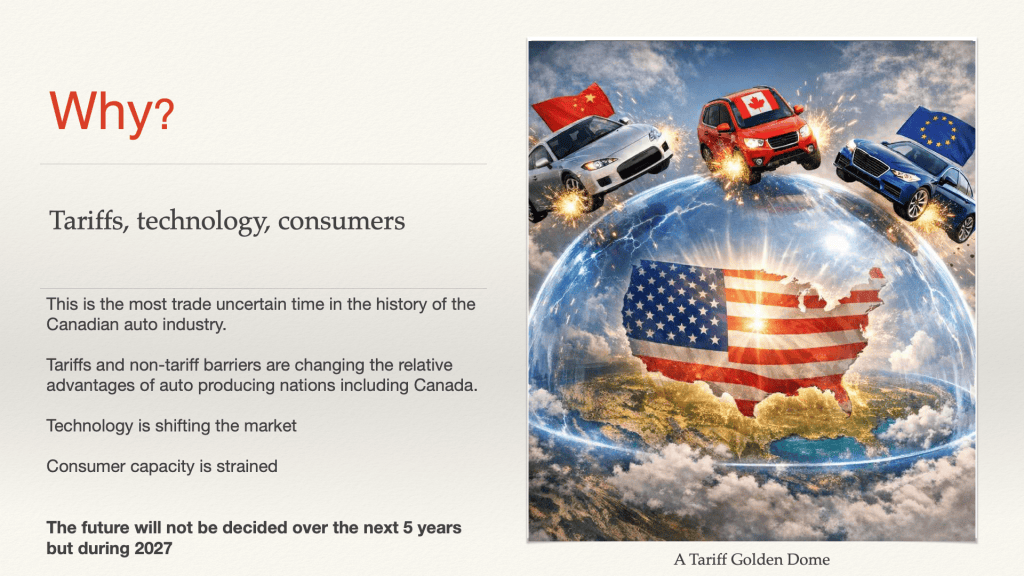
Why? Because a deal, if one comes, does not necessarily mean that all tariffs will go away. Prior to the resumption of formal trade talks, the best the US was prepared to agree to seemed to be a 15% tariff applied to the non-American or North American content in the vehicle. That would put the effective tariff on a vehicle in the range of 3.75 to 7% depending on the content rule. The problem with that proposal is it would lock in a cost imbalance between Canada and the United States that might be survivable in the short term but would inevitably lead to the demise of Canadian assembly plants.
And this would come at the same time that the US president has proposed import tariff relief for foreign automakers who invest in the United States. I should point out, that’s called duty remission and it is the very thing that the US opposes in Canada and that led to the president’s 50% tariff threat.
So anything short of full restoration of CUSMA benefits for Canadian autos simply isn’t good enough for the manufacturing sector.
But why would we think that it is possible to restore CUSMA while continuing to import Chinese vehicles into Canada? Given congressional pushback on allowing Chinese vehicles into the US, there is every reason to believe that the Trump administration will demand that Canada place new limits on Chinese imports too. Just as Chinese makers are about to arrive in earnest.
Finally, there is the reality that the marketplace is shifting. Interest rates are rising. Consumer debt is mounting. Concerns about connected vehicles and their impact on personal privacy and national security are growing. EV incentives are scheduled to decline. And environmental and fuel economy standards have been pushed off to the future even as gas and diesel prices remain high.
Today’s conference theme is ‘the next 5 years will determine the next 50’. I simply don’t think you will have to wait that long. 2027 is likely to be our Thelma and Louise moment. Do we grab the wheel and steer or do we continue over the cliff?
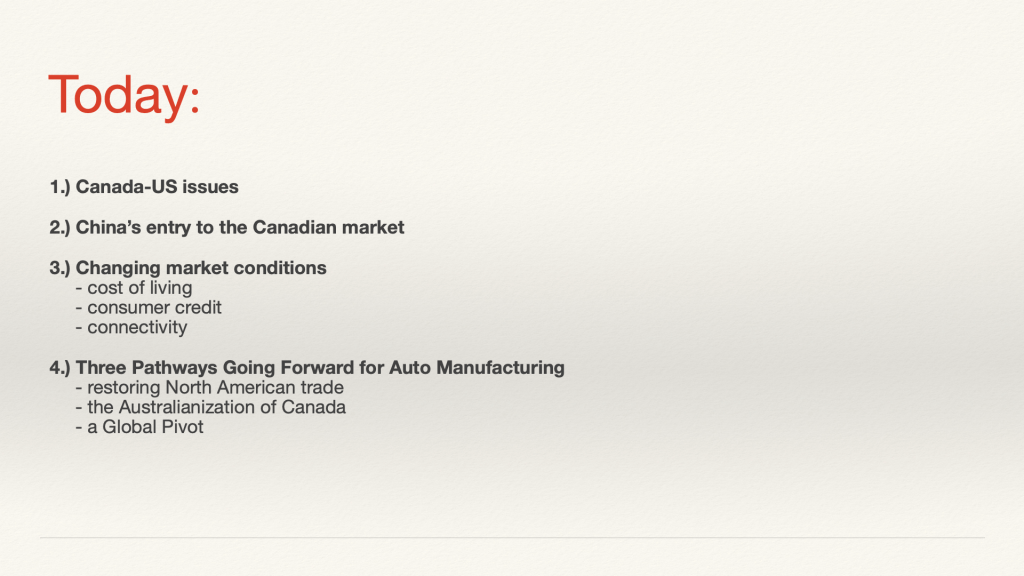
I have 25 minutes so I can’t cover everything in detail but I want to hit the following 4 areas:
Canada-US issues;
China;
Changing consumer and market conditions; and
Possible directions for the industry going forward
Let’s plunge right in…
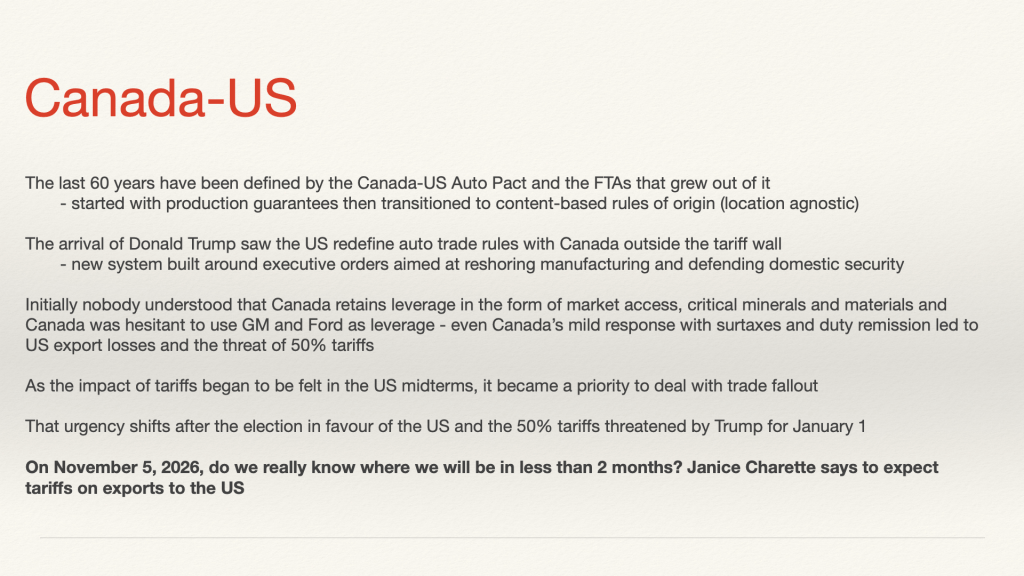
Canada and the United States have experienced periods of relative free trade and periods of high tariffs over our combined histories. But I think it is fair to say that from the Canada-US Auto Pact of 1965 right up to Trump’s return to office in January of last year, we have been living in a period where Canadians and Americans both believed that open trade would benefit not just North America but would lift economies around the world and reinforce Western values and Western democracies.
But there have been some worrying developments over that period that now become clear with the benefit of hindsight. Topping the list are trade rules that shifted from geographic-based production guarantees to site-agnostic content rules of origin within preferential trade deals.
In other words, the national production guarantees in the Auto Pact gave way to rules based on content added anywhere in North America. And that pattern was replicated across the rest of our global trade agreements. The problem is that, as Canada is neither the lowest cost manufacturing jurisdiction nor the largest market among our trading partners, the loss of national production requirements meant that manufacturing drifted away from Canada. You can see that in the Auto Sector. Over the past 25 years, Canada’s annual auto production has declined by over 58% — from 2.96 million units in 2020 to 1.24 million last year. That decline has come from the US brands that have downsized production, closed plants and lost product mandates to the US and Mexico.
So, in saying that he wanted Canadian auto production to relocate to the US, Donald Trump was not inventing a new trade threat — he just wanted to speed up what was already happening.
And whatever deal is finally cooked between Washington and Ottawa, if it locks in a price disadvantage for Canadian manufacturing or doesn’t reinstate geographic production rules, we will see continued erosion of the industry leading to the eventual closure of Canadian assembly plants. And to be clear, the auto parts manufacturers follow in the wake of the assembly plants no matter what kind of a positive spin the Automotive Parts Manufacturers Association might want to put on this.
In turn, I think you should listen very carefully to what Brian Kingston and the CVMA are saying (or at least to Ford and GM are saying — Stellantis has a different story). Ask yourself: are they concerned about market access to the US for Canadian made vehicles or are they obsessed with regulatory and other consumer cost issues in Canada? I submit that all they really care about is being able to obtain barrier free entry into Canada for vehicles built in the US. With that in hand, they will be like the Cheshire Cat and leave only their smile behind.
That is why I would tell you, and tell Canada’s negotiators as well, that if we want to eliminate barriers to Canadian exports to the US we have to apply pressure on the Canadian market for GM and Ford vehicles. Their cash cow and a product whose only meaningful export market is Canada is the full size pickup truck.
So back to Donald Trump and his newfound love of duty remission for companies that invest in the United States. We need to make it clear that we are prepared to increase the stringency of Canada’s remission orders, backed by surtaxes, to link production and imports on a 1:1 basis. Demonstrate a willingness to squeeze GM and Ford and you will get the attention of Washington. If for no other reason than the fact that Ford and GM lobbyists will be airlifted into the Capitol.
In the lead up to the midterms where Canada was an issue in swing seats, Canada’s path to a deal was clearer but I think it is worth remembering that, in the aftermath, a wounded Trump still holds significant cards and, if history is any indicator, he’s likely to lash out at someone. Where better than in an area where Republican and Democratic interests overlap? And that leads us to China…
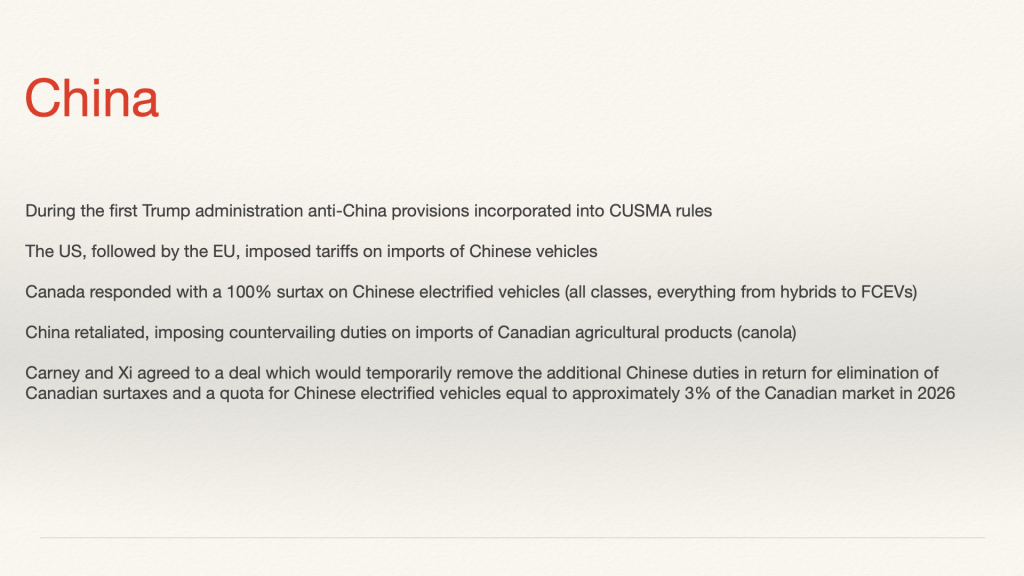
China was already high on the list of US concerns during the first Trump administration — so much so that certain provisions of CUSMA were specifically designed to break China’s stranglehold over the automotive supply chain — those included expanded core parts definitions and article 32.10 of the deal that requires prior notification of any trade agreement with China, information sharing and text review of proposed agreements and the right for parties to withdraw from CUSMA and replace it with one or more bilateral agreements if the China deal is unsatisfactory to them.
This is not just a Trump concern. Limits on imports of Chinese vehicles continued and expanded under the Biden administration and has been the subject of bills in both the House and Senate over the past two years. Moreover, US actions and subsequent trade movement by Chinese firms led to tariffs and other market restrictions in Europe and the imposition of a 100% surtax on imported Chinese-made electrified vehicles in Canada.
Note that I said electrified vehicles. Unlike Europe that focused on battery electric cars, Canada covered all classes of road going vehicles from hybrids through fuel cell vehicles. It was blanket coverage and it enraged the Chinese authorities who, not for the first time, decided to penalize Canada by restricting certain agricultural imports including canola.
Given the political dynamics of a federal Liberal government doing things that restricted Western Canadian exports, Prime Minister Carney quickly met with the Chinese leadership to broker a temporary deal to restore limited two-way trade. So what was in the deal?
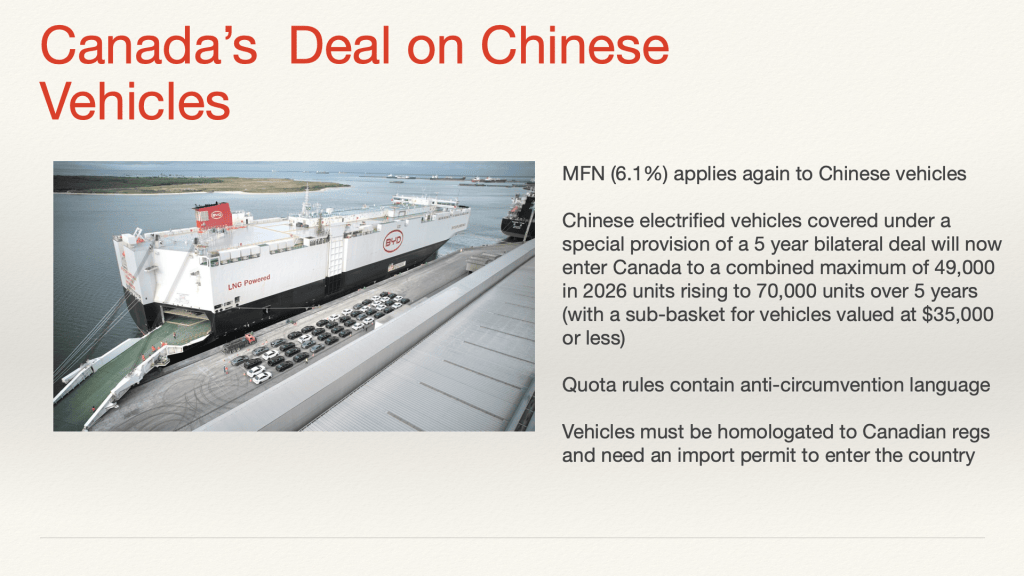
The MFN (6.1%) duty applies once again to all Chinese vehicles
However, Chinese electrified vehicles are now covered under a special provision of a 5 year bilateral deal allowing them to enter Canada to a combined maximum of 49,000 units in 2026 rising to 70,000 units over 5 years (with a sub-basket for vehicles valued at $35,000 or less)
The quota rules contain anti-circumvention language meaning that Chinese vehicles cannot be assembled in third countries to end run the quota.
Most importantly vehicles must be homologated to Canadian regulations and need an import permit to enter the country — something they cannot obtain without homologation.
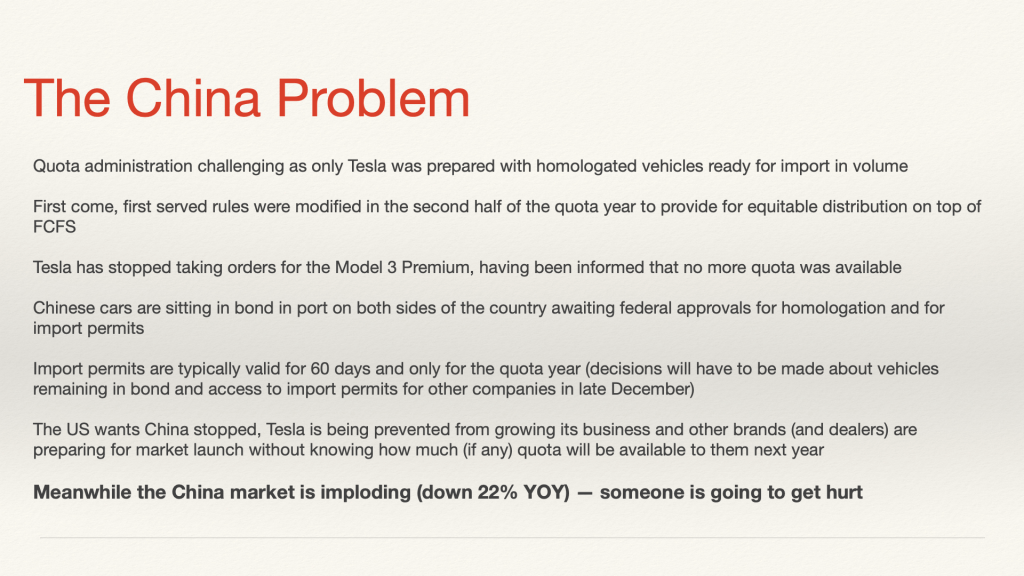
The problem is that not only does the end of the year coincide with the Trump tariff threat, it also comes at an important juncture part way through the first quota year on Chinese vehicles. Once again we could find ourselves squeezed between the US and China.
Concerning the quota, to the beginning of September, the first six months of the quota year, only about a third had been used. You might say that was to be expected because only companies with homologated vehicles were permitted to import from China during that time — a situation that favoured Tesla, Volvo/Polestar and Ford. But only another 603 vehicles were imported in September; none in October; and Tesla stopped taking orders for the Model 3 Premium, stating that it had been informed by the Canadian government that the quota available for Tesla had been used up.
While the bulletin issued by Canada in August stated that quota would continue to be available on a first come, first served basis in the second half of the quota year it also included separate language indicating that the Minister could ensure the equitable distribution of the quota. Equity, it seems, did not include letting the companies already importing from China grow their share above certain limits. And, as usual, those quota allocations were not made public — so you and I do not know how much quota has been set aside for which companies (or companies and brands and that distinction could be important but I can’t get into that now).
Let me simply say that equitable allocation is not how the market operates. Under this plan, companies will rise and fall according to policy not on the strength of offering products and prices that connect with consumers and set a solid foundation for business going forward.
Where’s the problem so long as the companies know and can plan accordingly? First, only vehicles that are fully homologated and imported by registered importers can obtain an import licence. Homologation is a detailed and lengthy process and I am advised that there are Chinese vehicles in ports on both sides of Canada awaiting clearance to enter the country. Unfortunately for them, import permits are typically only valid for 60 days so, with the quota year ending on February 28 of next year, decisions about permits will have to be made by end of next month. The perfect storm around New Year’s Eve keeps building.
So either homologation takes place and up to two thirds of the quota is suddenly filled; or the government has a change of heart concerning Tesla; or market entry of new brands is pushed into the new quota year, substantially undermining the launch of new Chinese brands.
To be clear, import permits are valid only for the quota year for which they are issued and can only apply to vehicles imported during the quota year. So miss this quota window and your next opportunity to import begins on March 1. What’s the difference? If two-thirds of this year’s quota is used prior to the end of February, that would represent something in the order of 30,000 additional vehicles available for sale in 2027. Without those, and with Tesla holding a significant percentage of quota going forward, the opportunity for a big bang launch of multiple Chinese brands is sharply reduced.
That has significant implication for dealers and consumers that I don’t have time to get into but I will say this: With the domestic market in China down 22% YOY and with companies like Chery predicting that only one in ten of Chinese new energy vehicle manufacturers is likely to survive a coming round of consolidation, there is risk that some brands will launch only to have to retreat from Canada because of a lack of available quota or other conditions that threaten their profitability and long term viability. And if I were Tesla, a company that has a clear record of using regulatory systems to its advantage, I might be firing up my legal department right now to address the issue of equitable allocation of quota. This issue will start to play out in real time in the early months of 2027.
By the way, I think the likelihood of Trump using Canada as his cat’s paw in dealing with China is increased by the fact that China’s temporary removal of export controls on critical minerals and their products ends in 5 days. Trump might not want to overplay his hand in a direct confrontation with China but I am sure he would be pleased to press Canada into service. So will there even be a China quota if a new Canada-US agreement happens?
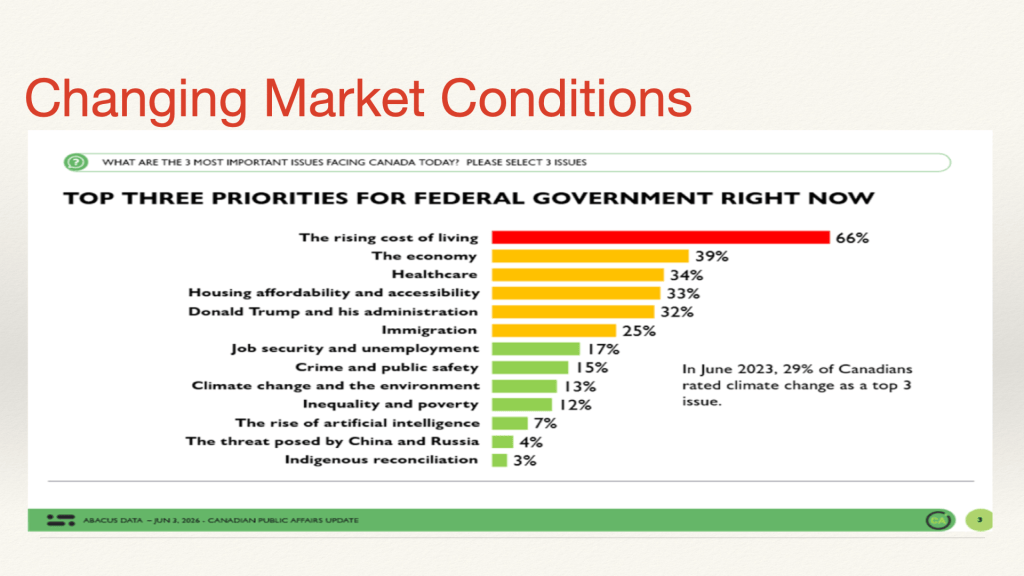
Let me change tack. Market success for manufacturers new or old and for dealerships is not just contingent upon tariffs and quotas and company strategies. Consumers need the capacity and willingness to buy vehicles.
Even back in June, a year and a half after Trump tariffs, relations with the US had slipped to fifth place on the list of Canadian’s priority concerns. Domestic economic issues around affordability took three of the top four positions amongst those concerns.
Consider what has happened since:
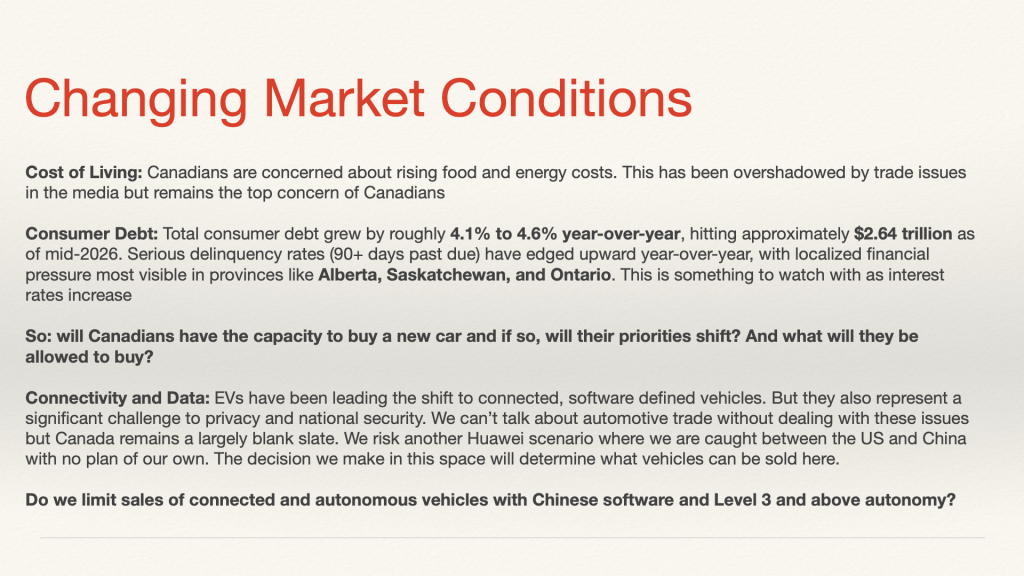
Total consumer debt grew by roughly 4.1% to 4.6% year-over-year, hitting approximately $2.64 trillion as of mid-2026. Serious delinquency rates (90+ days past due) have edged upward year-over-year, with localized financial pressure most visible in provinces like Alberta, Saskatchewan, and Ontario. Real estate prices are depressed and the housing market is challenging to say the least. Energy prices driven by US misadventures in the Straight of Hormuz have caused fuel prices to spike. Meanwhile, incentives for electric vehicle purchases are scheduled to decline next year. This may place an onus on companies to step in with additional incentives. This is something to watch as interest rates increase
So: will Canadians have the capacity to buy a new car and if so, will their priorities shift? What will they be allowed to buy if changing trade deals affect tariffs and quotas?
But there is another lurking consumer issue: connectivity and data security.
Here I am not talking about the national security and public safety issues associated with connected and automated vehicles. Although I do note the recent survey of software defined vehicle developers released by Blackberry subsidiary QNX. It showed that 83% of developers believe that software defined vehicles will become a major cyberattack target within the next three years. Interestingly, that sentiment is highest amongst developers in Canada, Japan and CHINA!
The Canadian government is doing its level best to make the situation worse with Bill C-22, currently before the Senate. I can’t get into the details of Bill C-22 but everyone in this room needs to take notice of the provisions of that proposed legislation and the impact it might have both on encryption and access to customer data.
To date, Canadians have not been too concerned about data privacy and security. In that sense we are closer to American than European attitudes toward privacy and most people take the not unreasonable point of view that their phones are already harvesting data so cars don’t represent a significant additional risk.
That said, I think it is worth watching the public pushback against Flock cameras (automatic licence plate readers) in the US. If government cameras positioned at public intersections that capture information about your car are raising concerns, how long will it be before the issue of car mounted cameras and always on microphones combined with metadata monitoring by government agencies becomes a consumer reason for rejection in the showroom. Unlike your cellphone, you cannot turn off the data stream from your car at will. And that same QNX survey showed that a growing number of developers, some 78%, believed that a lower tech, “deliberately minimalist” vehicle could be a hit with consumers.
Will trade talks force us to limit certain technologies – particularly from China – or will a social backlash or national security concerns cause Canada to take other actions? Hopefully companies are prepared no matter what direction this takes. And that brings me to the fork in the road…
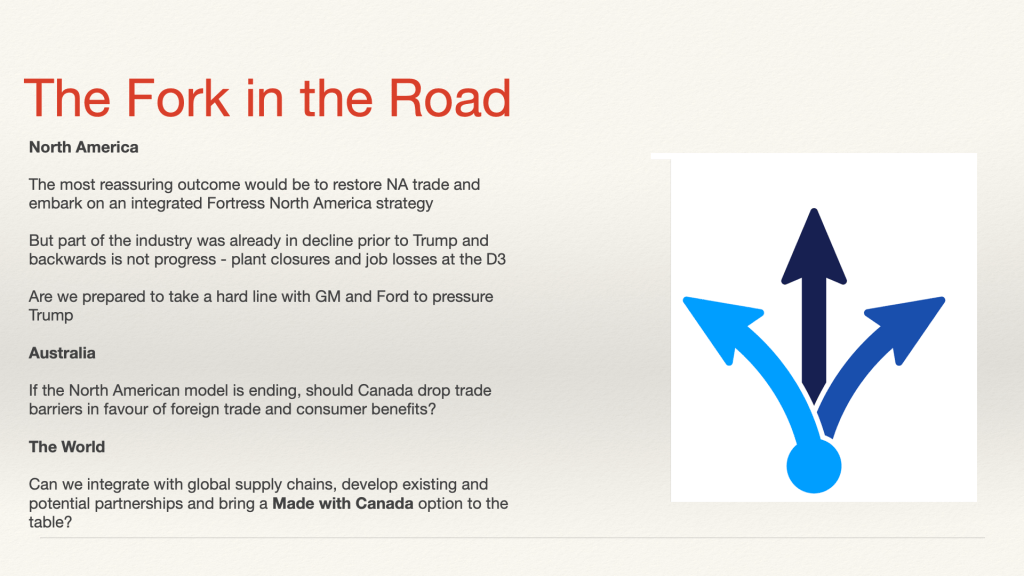
In a recent blog post, I set out three possible directions for the future of the Canadian auto sector. I won’t get into them in detail but those pathways include the familiar and comfortable return to a fully integrated North American market or a swing to a more integrated global market where a Made with Canada partnership with Japan and Europe might trade market access and investment for secured access to Canadian critical minerals, specialty metals and low carbon energy.
If returning to North American primacy is is the path Canada chooses, the result needs to be more than just a reset of our pre-2025 trading relationship. That was already a dead end. If, on the other hand, we switch to globalized supply chains and new partnerships, that will be nothing less than a moonshot. It will require a fundamental rethink of all of our industrial policies, regulatory systems and business arrangements.
So I am afraid that there is a lazy third way that Ottawa has already considered and that is to follow in the path of Australia and simply open the market to all contenders while extracting free trade openings for Canadian commodity and services exports (an outcome that might be concealed behind a part-way tariff deal with the US).
Australia and Canada are very different places even if there are similarities in our economies. Our proximity to the United States is both a blessing and a curse and the events of the past year and a half have demonstrated that we cannot rely on the kindness of strangers. Negotiated market openings whether in the US or across the Atlantic or Pacific need to be actively nurtured and defended, not just left to chance. And if you have been watching the Australian car market in particular you will have noticed the Chinese onslaught that is resulting in value destruction for preexisting brands and their dealer networks.
Whichever path Canada takes, it must actively manage the results. And that leads me to my last point…
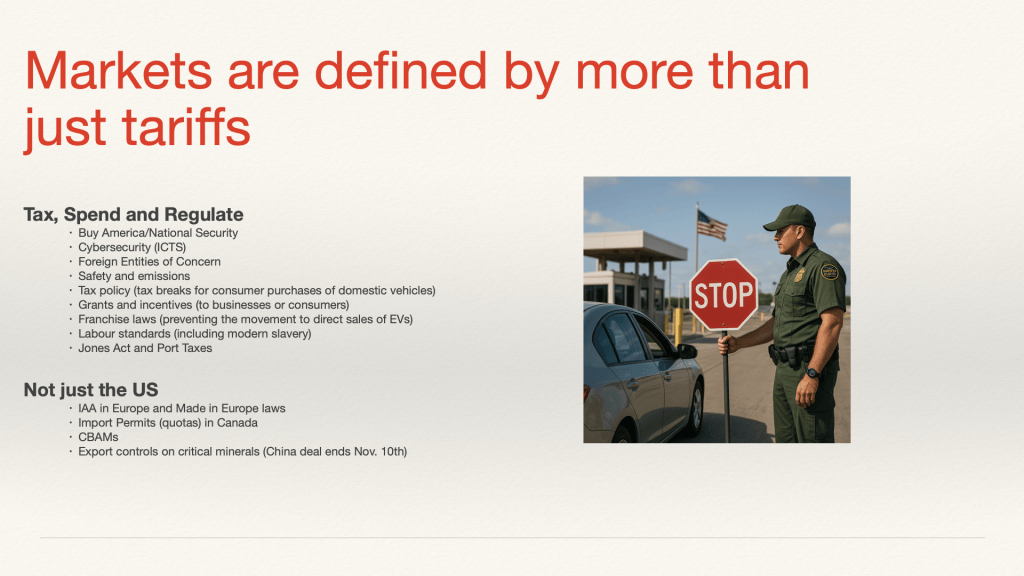
Markets are defined by more than just tariffs and quotas.
As the US has demonstrated in recent years through everything from the Biden Inflation Reduction Act and its support for battery supply chains in the US to Trump’s regulatory rollbacks and tax incentives for buying American assembled vehicles, how governments tax, spend and regulate have transformative effects on industry. Just look at the billions of dollars of EV losses incurred in the US as a result of changing policies.
And those impacts are not limited to the US, whether it is pending Made in the EU rules, carbon border adjustment measures (CBAMs), or conflicting product standards in Europe or state ownership of car companies and market intervention by China.
Canada will also have to decide which tools it will use, how it will align with global standards (associate membership in the EU anyone?) and how it will protect Canadian consumers and businesses from unfettered competition.
And because the world is turning quickly we really can’t waste time making up our minds.
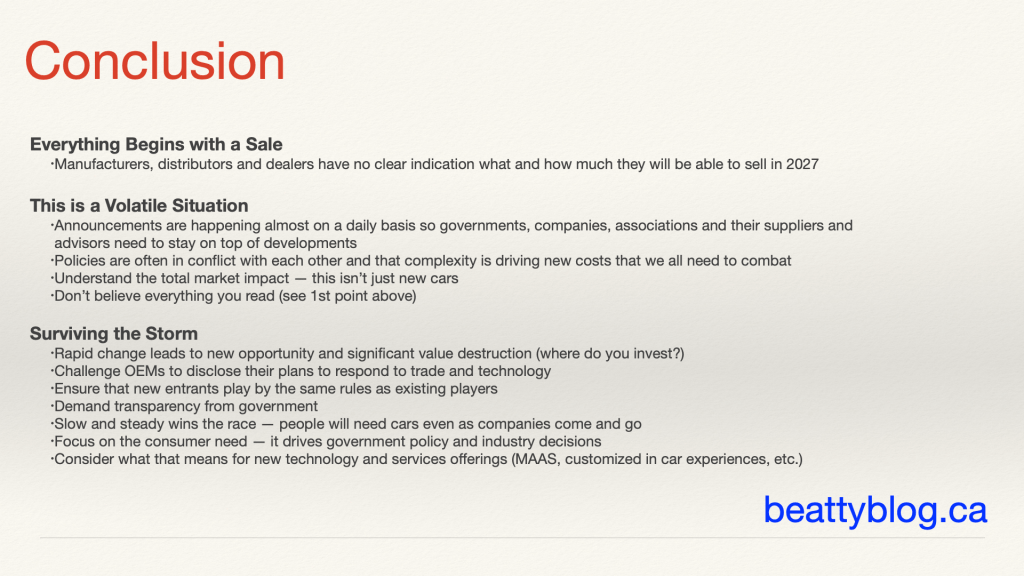
So let me wrap up with this: It’s the end of the world as we know it. And only some of us will feel fine.
Canadians will need cars. But what they will look like, how they will operate, which brands will offer them and how much they will cost are still open questions going into 2027.
Governments need to make decisions. In turn, you need to demand transparency from them. You need to make your voices heard. And most of all, you need to stay close to consumers and their needs. Because at the end of the day, everything in the auto industry begins with a sale. And working to meet the customer’s needs (even the ones he or she is not yet aware of) is the best way to ensure that sale.
And finally, on the subject of sales, let me close with a plug, if you want to stay on top of these issues I invite you to subscribe to my blog with its occasional diatribes on these subjects — it’s free. Or if your needs are more technical please reach out and the trade specialists attached to Trade Facilitation Services in Ottawa and I would be pleased to work with you. Between us we have a long history of managing tariffs, quotas and trade rules and we would be delighted to help you meet the challenges coming in 2027.


Leave a Reply