OK. I know this is overly dramatic and the world will not end on January 1st 2027. There is even a possibility that all of Canada’s outstanding trade disagreements with the US could be resolved by that time. However, I think it is important to recognize that getting to January 1st without a breakthrough in trade talks will topple a domino that could have long-lasting and far-reaching effects.
Threatened 50% US tariffs combined with the real entry of Chinese manufacturers into the Canadian auto market represent a one-two punch to existing manufacturers and their suppliers. It also means uncertainty and potential value destruction for dealers who have built their businesses around the rules that have governed the car business in Canada since the implementation of Auto Pact more than 60 years ago.
The impasse between Canada and the US requires a fundamental breakthrough if normal trade in automobiles is to be restored. Consider negotiations in your own life. How likely are you to make concessions if you are not pressed by external conditions or the belief that the person you are negotiating with retains some leverage? At the moment, the US believes it holds all the cards so Canada needs to push back and demonstrate that the path the US has chosen leads to mutually assured destruction of our auto industries. Since we have very little to lose in the face of the US threat, we might as well let them know we intend to take them down with us.
A lengthy policy paper follows below but, knowing that few people will have the time or patience to wade through it, let me summarize it as follows:
The Next Phase of Automotive Trade Policy for Canada
Canada is approaching a critical juncture in its automotive trade policy as the United States prepares to impose 50% tariffs on Canadian vehicle exports effective January 1, 2027. This development threatens a deeply integrated North American auto industry that has operated under harmonized conditions since the 1965 Auto Pact. Immediate action is required to protect employment, stabilize production, and maintain Canada’s broader industrial base.
Key Challenges:
- US tariffs render Canadian exports to the American market uneconomical, risking widespread plant shutdowns and layoffs.
- The auto sector is Canada’s second-largest export industry and a cornerstone of the domestic economy.
- Delayed or inadequate response could lead to structural decline and long-term loss of industrial capacity.
Strategic Imperatives:
- Triage and Short-Term Stabilization:
- Implement measures to preserve production and employment through targeted market incentives, fleet programs, and revised duty remission tied directly to Canadian output.
- Support manufacturers with extended EI benefits, consideration of CKD production, and suspension of EV subsidies for imports.
- Apply Pressure to the US:
- Leverage Canada’s importance as the largest export market for US vehicles, particularly full-size pickups, by tightening remission programs and threatening targeted surtaxes.
- Time retaliatory measures strategically to influence US negotiations.
- Options for Long-Term Pathways:
- Restore North American Trade: Pursue a managed-trade framework that satisfies US content, sourcing, and strategic supply chain requirements while preserving duty-free exports.
- Global Pivot: Reorient Canadian production toward global markets using Canada’s trade agreements, green industrial capabilities, and supply chain integration with Asian and European partners
- Australian Option: If maintaining automotive manufacturing proves untenable, implement an orderly industry exit, with robust worker transition and supplier reallocation strategies.
Conclusion:
Canada must act decisively to address the looming trade crisis. While restoring US market access remains the preferred solution, well-prepared alternatives—including a global pivot or an orderly wind-down—are essential. A focused triage plan, coupled with credible leverage and an independent, expert policy task force, will position Canada to either secure a negotiated resolution or protect its economic interests in a post-2027 environment.
As for the impact that Chinese makes could have on the Canadian market, that is a subject for another day but there are a number of facts that should be giving all stakeholders reason to pause and take stock. They include:
1.) the Canadian government has decided to provide managed and equitable access to import quotas (there simply isn’t enough quota to go around if all of the current importers are joined by another 4 or 5 Chinese brands however the market does not operate on the quota year established by the government and competitiveness and equitable quota allocation are not compatible),
2.) the reason Chinese makers are pursuing the Canadian and other export markets is that their domestic market is experiencing a race to the bottom (involution) where profitability is hard to achieve, over-production is rampant, sales are falling and companies will consolidate or die;
3.) domestic fragility has Chinese companies pursuing profits abroad which means pricing for the Canadian market is unlikely to be as low as consumers expect and increases risk for anyone opening a Chinese-brand dealership in Canada; and
4.) if there is a deal to be had between Canada and the US, it is likely to include a demand that Canada further limit imports from China.
All in all, 2027 is likely to be a watershed year for the Canadian auto industry and we need a strategy to deal with that reality. What follows is my attempt to address those considerations and offer some ideas for consideration and debate.
Warning: It is long and detailed and not for the faint of heart!
The Next Phase of Automotive Trade Policy for Canada
Introduction
There is a growing narrative in Canada that every time this country has negotiated a trade deal with the United States negotiators have reached a point where they have had to back away from the table to communicate the seriousness of our negotiating position. According to this line of thinking, breaking off talks causes the US to take our concerns more seriously and ultimately leads to an acceptable outcome for both parties. For the promoters of this theory, the pattern seems likely to repeat in the current impasse with the United States and result in some form of normalized trade in the coming weeks.
While granting the possibility of such an outcome, it is important to consider what might happen if no breakthrough in negotiations – particularly in automotive trade – happens prior to the January 1, 2027 deadline for the imposition of 50% US tariffs on Canadian vehicle exports.
This note posits three possible pathways or outcomes that Canada must prepare for as well as making the case that Canada must design and be prepared to implement a triage strategy for January 1st of next year. That triage strategy would serve to hold as much Canadian production and employment as possible while Canada takes the time to determine whether it will be possible to:
- restore trade with the United States under some set of revised rules;
- pivot toward greater reliance on global markets and supply chains; or
- prepare for the eventuality that Canada follows the Australian model and disbands its domestic auto manufacturing sector and related supply chain.
Setting the Stage for 2027
The best outcome for the Canadian auto industry would certainly be some form of normalization of trade with the United States. The industry across North America is deeply integrated because of the over 60-year period of market harmonization that flowed from the implementation of the Canada-US Auto Pact in 1965.
To unwind that relationship would require Canadian car makers and parts producers to service new global markets. On the parts side, it would likely mean hiving off production to plants in the United States that would be dedicated to serving US assembly plants. In the case of Canadian vehicle assembly, future survival would depend upon achieving increased domestic market share and back filling for global production that would be diverted to the US in the absence of Canadian assembled vehicles (i.e. in the absence of a deal with the USA, Toyota and Honda Japan should consider servicing the US market with direct exports, attracting 15% duty versus 50% payable on Canadian exports: leaving Canadian production to supply and back fill the diverted sales to other regions formerly supplied with Japanese production). What would emerge from this restructuring might be more resilient but is also likely to be smaller than the current Canadian production base as it would have to compete on a global scale without the benefit of proximity to markets outside of Canada. Given the costs associated with creating the conditions necessary to support continued production, serious thought would have to be given to whether to maintain the industry or to direct resources to other, more promising sectors of the export economy. Although it is hard to imagine any alternative sector that can match the size and depth of the Canadian auto sector.
To be very clear, doing nothing is not an option. The broader auto industry is the second largest export sector of the Canadian economy, is a massive generator of high paying industrial jobs and a significant domestic market for steel, aluminum and other Canadian produced materials. The industry’s highly qualified personnel represent a talent base which the country will need to power any other industrial activity so, at a minimum, a glide path to transition auto sector employees to other roles in priority sectors such as the energy and defence industries will be required.
Building robust, new economic activity or sectors and redeploying personnel will take time and significant public expenditures so our priority should be to reinforce and reimagine the auto sector if possible. At a minimum we need to draw out the timeline required for an orderly transition.
It is also important to understand that the building of an integrated North American industry was the product of a detailed industrial strategy implemented by the Canadian government the assistance of outside advisors beginning in the early 1960s. While industry representatives are an important sounding board for any tactical trade deliberations as once delivered under Canada’s SAGIT regimes, they are less likely to be able to provide comprehensive policy alternatives. In framing its “Plan B” strategy, Canada should once again turn to a neutral, external source of policy advice, including possible Royal Commissions, as it did in the early 1960s.
While that work continues, given that restoration of trade with the US should be our first priority and given Secretary Greer’s recent comments that the US is getting what it needs from the trading relationship with Canada and is in no rush to return to the negotiating table, Canada should consider increasing pressure on the US prior to the January 1st deadline for the new US tariffs. The US must come to understand that US businesses and workers will suffer if trade between Canada and the US ruptures and that begins with understanding what leverage Canada has in this dispute.
Triage
If we are approaching January 1 with no obvious prospect of a renewed trade deal, Canada needs a triage strategy to sustain the Canadian auto industry until a go forward strategy can be implemented. A planned triage strategy, as outlined above, provides the breathing space to properly explore three potential pathways including restored trade with the US, a pivot to global trade or a planned exit from auto production. Triaging this situation requires a strategy to limit the period of uncertainty as well as bolstering alternative market opportunities (keeping as much production and employment intact as possible) while Ottawa determines next steps.
Canadian production for the US is uneconomic in the face of 50% tariffs. Plants already closed in Ingersoll and Brampton would not reopen in such an environment, and plants scheduled to begin production soon such as the Ford Oakville plant are likely to delay start up, perhaps indefinitely. Existing auto plants would be likely to limit production to what they need to supply the Canadian market and then move to reduced shifts and layoffs. As a result, Ottawa’s objective should be to limit the duration of any economic uncertainty as much as possible and begin the transition to one or more of the proposed pathways as rapidly as feasible. That process must begin by upping the pressure on US negotiators to return to the table.
Step One: Apply Pressure
The fact that the US telegraphed its January 1 tariff actions seems to suggest a desire on the part of the Americans to achieve a negotiated settlement. By itself, however, this US threat of tariff action represents a lopsided effort to influence the outcome of such talks. Canada needs to apply pressure of its own and it doesn’t need to look beyond the auto sector for retaliatory measures.
In recent decades, Canadian automotive policy has made the mistake of thinking that because 85% of Canadian production is exported to the US, we can separate policies affecting the domestic market from industrial policy considerations. This is why Canada felt it was possible to set unique trade and regulatory practices for the Canadian market while simultaneously pursuing new manufacturing investment that was largely directed at production for the US market. The US and Canadian markets are closely linked and consumer tastes and requirements in Canada parallel those in the US. Consequently, the Canadian market is by far the largest export market for US made vehicles, particularly the US industry’s most specialized product and cash cow — the full-size pickup truck. Canada needs to leverage the importance of that market to force negotiations to an early conclusion.
With the US January 1 trade action already notified by the US, it is time for Canada to say how it will respond. The US has already acknowledged that Canada’s duty remission strategy has hurt US exports. Those remission orders were the subject of a public review earlier this year, but the Canadian government has not announced the outcome of its consultations or possible future policy directions. Now, in advance of the US midterms and providing adequate lead time before the US-imposed January 1 deadline, it would be timely to set out a proposed go-forward strategy.
The 25% surtax that Canada previously applied to imports of US made vehicles has had an impact on imports of vehicles by manufacturers who do not have a production footprint in Canada. Import sourcing for Canada has shifted to other countries to benefit from preferential tariff treatment under Canada’s trade deals with those jurisdictions.
This sourcing impact, that was widely attributed to Asian manufacturers, was also driven by Tesla, which diverted much of its sourcing to China and Germany. Since that aspect of the policy appears to be having the desired effect, there is little reason to increase that duty rate. However, there is a strong incentive to expand the application this trade mechanism.
When the remission strategy was originally put in place, Canadian manufacturers were granted remission sufficient to cover their historic levels of imports in return for not reducing Canadian production (or in the case of Ford, seemingly for a commitment to restore production). Once again, federal policy severed domestic and export market concerns in a way that limited the effectiveness of the policy. Rather than granting import volumes based on historic import values, Canada should have restored Auto Pact principles and tied remission directly to production. Canadian production was at low ebb because of plant retooling and other recent corporate investment decisions in the sector when the policy was implemented. As a result, remission entitlements undoubtedly needed to be more liberal at the outset, but the rule should have ramped up requirements to something approaching a 1:1 import to production ratio over time. Also, given the role that powertrain plays in defining the fundamental characteristics of a vehicle, it would have been important to provide some import credits in a ratio reflecting the value contributed by engines and transmissions in a modern vehicle (perhaps up to 10% of the value of an import credit for an engine).
It is possible that the framers of the Canadian policy thought that remission would be a short-term measure that would only be needed for a relatively brief period while CUSMA was reviewed. If so, that optimism has not been borne out. Canada should now reexamine the production to sales ratio.
By making remission entitlement directly related to Canadian production, the remission program would narrow the benefits available to US based brands. While some companies might argue that the Canadian market is too small to support sufficient production to cover those companies’ needs for imports from the US, it is important to understand that imports from other countries including Mexico would not be impacted by this policy. Each of the US brands has plants outside of the US as well as joint venture partners that they could turn to for additional supply.
Where that flexibility is limited is in their North American product specialty and primary profit generator — pickup trucks. The tariff and non-tariff barriers that the US has erected around these vehicles (e.g. the US “Chicken Tax”, relaxed fuel economy and emissions standards, etc.) has limited foreign competition. As a result, the Canadian market would need to be serviced either from Canadian or Mexican plants or with vehicles imported under the Canadian remission program. Ford offers a clear example of why a targeted pickup truck strategy would be impactful.
The company has long claimed the number one sales position in the Canadian auto market with sales of the F-150 pickup. In 2025, Ford sold a total of 294,418 vehicles in Canada. Of those, F-Series trucks (including the F-150) totaled 138,470 units. Ford is proud to advertise that all its F-Series trucks are built in the United States (pending start of production at Ford’s Oakville facility). In other words, F-Series accounts for almost half of Ford’s annual sales volume in Canada and there is no alternative available to Ford to source the vehicles in a third country. As a result, tightened duty remission rules would significantly impair their ability to continue sales in Canada without Canadian production. The loss of the Canadian market would have a significant impact on their overall business in North America. Ford’s 2025 US sales of F-Series trucks were roughly 800,000 vehicles. In other words, Canada accounted for roughly 15% of combined Canada/US volume. The loss of the Canadian market would likely result in the closure of a US plant and further impair Ford’s already lagging profitability.
This strategy would impact all three of the Detroit based auto makers. The recent announcement that Stellantis is seeking to repatriate their heavy-duty pickup production from Mexico to the US suggest that the proposed Canadian policy shift would also impact their forward planning and would layer on top of any separate action Canada might take to require Stellantis to pay penalties for any failure to meet its contractual obligations in this country. The beneficiary of any stumble by Ford and Stellantis would be General Motors, who does operate truck plants in both Canada and Mexico and therefore would be positioned to gain market share. This offers GM a strong incentive to continue building trucks in Canada.
Canada may or may not want to draw public attention to its retaliatory tariff strategy. That decision comes down to whether the threat of tariffs would be helpful in generating public pushback against the Trump tariff stance. Duty remission is too arcane to be understood by the broader public so an announcement of increased tariffs might be appropriate. In that case, Canada should consider raising the surtax on all classes of pickup trucks to 50% to respond to the US threat of tariff increases effective January 1st. There is no need to adjust the surtax on other vehicles imported from the US as the White House has already acknowledged that the tariff has caused companies to divert sourcing away from the United States. A careful political calculus is required to determine the precise timing for such announcement. Should it happen prior to or after the US midterms?
Step Two: Short Term Stabilization
Given that the threat of US tariffs for January 1 is already known, it is reasonable to assume that Canadian assemblers are rushing to move as many vehicles as possible to the US before the end of the year. Normally manufacturers who are aware of potential border friction will attempt to assemble safety stock on the ground to ensure that sales can continue while trade issues are addressed between governments. In that case, the US side might trade production allocation with the Canadian sales arm of a company, pulling forward production to beat an impending tariff deadline. In turn, Canadian manufacturing would focus on meeting deferred Canadian demand in the early days and weeks following any imposition of US tariffs. However, the limited size of the Canadian market means that, particularly at Honda and Toyota who currently account for over three quarters of Canadian production, production would have to quickly scale back, resulting in shift cancellations and potential layoffs and that impact would ripple through their Canadian supply chains.
In response, Canada should work to maximize domestic market potential for Canadian assembled vehicles. This would include some mechanism to lower the acquisition cost of Canadian made cars and the elimination of any conflicting federal policies.
While some have argued for the elimination of sales taxes on Canadian made vehicles, this is an inefficient policy tool. For example, incentivizing incremental sales for vehicles such as the Toyota RAV4 or Honda Civic, the sales leaders in their respective classes, means foregoing taxes on large numbers of consumer purchases that would already have taken place each year before the first incremental sale is made. So, for example, if the 5% federal tax were to be waived on RAV4 with an average retail price approaching $40,000 each purchaser would benefit from a $2000 incentive in the form of foregone taxes. Toyota Canada sold over 75,000 RAV4s in 2025 (most, but not all, made in Canada). That means that the federal government would need to forego $150,000,000.00 in tax revenue before the first incremental sale was recorded. There are better ways to spend that money.
A more targeted incentive could be applied to purchasers of fleet and ride hailing vehicles, combining sales tax reductions with accelerated capital purchase deductions. Combined with requirements for the vehicles to be made in Canada and meet stringent GHG/fuel economy requirements, this strategy would improve the performance of the on-road fleet while also ensuring support for domestic manufacturing, which disproportionately favours the production of hybrids and other fuel efficient vehicles. Setting aside other corporate, delivery and taxi fleets, with 80,000 licensed ride hailing drivers in the GTA alone, there is significant short-term potential for new sales as a bridge to other policy outcomes. A similar, targeted fleet approach could be taken with trucks and minivans.
The government should abandon its opposition, in the short term, to CKD production in Canada. Keeping assembly plants in operation should be a priority and government departments and agencies should work closely with Canadian manufacturers looking to restart or maintain assembly plants. Consideration should be given to speeding certification of vehicles built in joint venture partnerships with Canadian manufacturers including the possibility that Canada would extend recognition to vehicles built to UNECE standards in a Canadian plant.
Federal EV incentives, which subsidize imported vehicles should be suspended for the duration of the triage stage.
Finally, even with the measures outlined above, manufacturers may struggle to maintain production. An urgent review of EI benefits should be undertaken to ensure that companies and their workers can withstand the short-term impacts of any US trade blockade. While the unionized plants in the assembly and parts sectors can make use of specific layoff provisions in their collective agreements there is no similar, automatic option for the non-union sector, where a layoff can be interpreted as constructive dismissal. In these extraordinary conditions, some provision for extended layoffs with topped up income and benefits should be available to non-union staff across the industry.
It should also be noted that other export sectors of the Canadian economy were hit by new tariffs imposed by the White House in early September that were said to be in response to Canada’s retaliatory tariffs on cars. Any triage plan for autos should also offer support to those other affected sectors, which is a subject for a separate analysis.
Choosing a Path Forward: Three Options, One Decision
With a plan for short term stabilization of the sector in hand, attention needs to turn to a longer-term pathway for the industry. In order of priority the main options would be:
1.) Respond to US concerns while restoring integrated trade in North America;
2.) Pivot to realign the Canadian industry around global supply chains for emerging technologies; or
3.) Follow the example of Australia and wind down the industry in favour of expanding trade in other goods.
Path One: Restoring North American Trade
Canada’s objective to date has been to respond to US trade concerns while attempting to restore largely unfettered trade in parts and automobiles in North America. While it has long been a US trade objective to redirect automotive investment from Canada to the United States, previous US administrations, including the first Trump administration, were content to build managed trade agreements designed to tie the benefits of US market access to enhanced regional sourcing requirements, labour value minimums and adherence to US standards. The result has been ever-tightening rules of origin that marched up to the limits of what was feasible for the industry but never prevented trade. Furthermore, these increasingly strict rules of origin are locationally neutral that, by definition, favour production in the largest market or the market that features the most competitive cost structure. The second Trump administration has changed that pattern. It has sought to impose new sourcing requirements and place limits on non-originating content from certain countries, while applying tariffs even to CUSMA-qualifying content in vehicles. While the US has limited the application of new tariffs to parts used in manufacturing in the United States, the net effect of applying tariffs to Canadian and Mexican content in vehicles imported to the United States has been to incentivize Canadian plants to increase US sourcing to the detriment of local suppliers.
Aside from the president’s overarching objective of relocating Canadian assembly plants to the US, the major stated goals of the US can be described as follows:
- Increase the US content in cars built and sold in the United States while refusing to recognize Canadian or Mexican content in the duties they want to maintain on imports from these economies;
- Eliminate, to the extent possible, Chinese content from the supply chain;
- Institute changes in the trade agreement(s) with Canada and Mexico that do not require the administration to seek approval from Congress;
- Achieve, at minimum, balanced trade with all trading partners;
- End Canada’s automotive surtaxes and remission programs; and
- Trade continued access to the US auto market for net new market opening concessions from Canada (e.g. dairy).
In trying to respond to these US demands, it is important for Canada to understand where our interests overlap. For example, we may not want permanent changes to be made to CUSMA but might find benefit in a temporary arrangement that sits on top of the free trade agreement — one that might be peeled away in future. Similarly, it might be useful to Canada to be forced in some measure to limit the types of Chinese technologies incorporated into vehicles manufactured or sold in Canada so Canada could “reluctantly” agree to certain conditions. In the case of US content requirements, Canada might find that there is little practical impact from agreeing to US content up to a certain percentage. However, political tradeoffs affecting other industries or cultural safeguards might be a red line for Canada that need to be considered in any trade strategy.
With those considerations in mind, the first pathway should reflect a set of conditions that Canada would agree to without the need for escalation in the trade dispute between Canada and the US but that might only be achievable following January 1 and/or the imposition of new retaliatory tariffs.
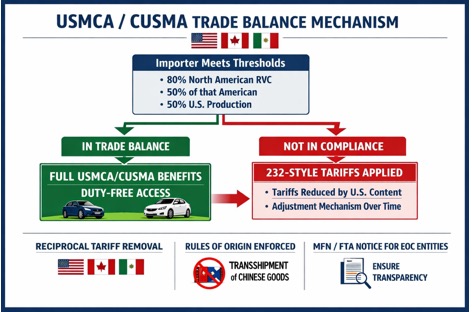
This proposed approach would see the US maintain its Section 232 tariffs on automobiles forming a layer on top of the CUSMA. Canadian built vehicles that met certain conditions would be permitted to access the full benefits of CUSMA while non-compliant vehicles would be subject to 232 tariffs. This policy approach is illustrated in the chart at the end of this section.
As today, cars that met none of the CUSMA or additional requirements would be subject to full 232 tariff treatment. For cars meeting CUSMA rules of origin, US originating content could be deducted from the value for duty of a car imported to the US and the applied duty rate might be reduced from 25% to a level competitive with other preferred American trading partners (e.g. the 15% rate of duty that applies to Japan or the EU). Added to these rates would be a third applied rate of duty that would be unlocked by a car meeting enhanced rules (e.g. 80% RVC with 50% of that sourced in the United States). This rate could take the form of a tariff rate quota only available to importers for whom American assembled vehicles account for a minimum of 50% of annual sales in the US. This would place an onus on importers to manage production and sales in a way that, at a minimum, kept American production and sales in balance (a form of reciprocity). This threshold requirement would also effectively require any company seeking to establish itself in North America to invest first in the United States to qualify for duty free trade. The revised RVC requirement could be combined with a tightening of core parts definitions to require additional strategic materials and technologies to be sourced in the region.
In addition, the parties might agree to certain standards around security of supply chains and data flowing from vehicles that would restrict the participation of brands from non-market economies from the benefits of the agreement. In turn, Canada and Mexico would agree to eliminate surtaxes on any vehicle meeting the terms of the new agreement and agree to eliminate those surtaxes in full if US 232 tariffs are ever removed on vehicles originating under CUSMA rules in Mexico or Canada.
This would leave scope for the US to maintain tariffs on vehicles that only met MFN rules of origin, reducing the possibility that Chinese manufacturers would be able to use either Mexico or Canada as a manufacturing base for accessing the US market. Canada would also suspend its automotive remission orders while this agreement remains in effect, pending complete removal if 232 tariffs are eliminated and would also agree not to pursue TRQ benefits under the automotive side letter that was signed as part of the original CUSMA pact.
This proposal would:
- maintain 232 tariffs;
- Not require Congressional approval;
- Lift the remission orders;
- Respect the US proposal for a 15% tariff deal with relief for US content;
- Increase local sourcing in the US under a more stringent set of rules;
- Limit Chinese intrusion into strategic supply chains;
- Create an incentive for reshoring of manufacturing or for net new investment in the US; and
- Maintain liberal access to the Canadian and Mexican markets for US exporters.
In turn, it would permit exports to the United States from Canada to resume at a 0% rate of duty with relatively small adjustments to current sourcing practices under a “temporary” arrangement that might be revised or lifted in future as part of a more comprehensive renegotiation of CUSMA.
Path Two: The Global Pivot
If the tariff impasse continues, Canada needs to consider what alternatives exist to bolster automotive production in Canada. The obvious response to a border dispute with the United States is to explore what, if any, options exist for Canadian exporters to service both an expanded domestic market and more far-flung global markets.
In this scenario, a Canadian surtax on imported US vehicles would continue and the revised duty remission program (a modified 1:1 approach) outlined above would be implemented to anchor some level of D3 production in Canada. This approach would also provide the larger vehicle assemblers, Toyota and Honda, with the flexibility to import vehicles duty free from the US so long as they maintained sufficient Canadian production.
Unlike the D3, Honda and Toyota brands are represented in a wide array of global markets with the models they make in Canada. Faced with a 50% tariff wall, neither company could afford to continue exporting to the US from their Canadian production base. On the other hand, Japanese production would face a lower 15% duty on entry to the US. As a result, a near term strategy would be to substitute Japanese production for Canadian cars in the US and use Canadian production to service markets previously supplied from Japan.
To make this approach feasible, the companies would have to modify supply chains to manufacture vehicles homologated to different external market standards, revise logistics to ensure that sufficient railcar, port and shipping capacity existed to handle large volume exports and the Canadian government would need to ensure clear access to export markets including measures such as dedicating Tariff Rate Quotas under the CETA to this project and possible limited recognition of UNECE regulations to permit Canadian-built, globally compliant vehicles to be sold in Canada (these vehicles could also be sold in Mexico, which recognizes those same global standards).
To convert this pivot to global markets into a lasting arrangement, the Canadian government would need to begin discussions with their Japanese counterparts and with the involved manufacturers to address the necessary conditions to stitch Canadian plants into a global supply network. An important card for Canada to play in any discussions with Japan would be to provide global risk mitigation by guaranteeing Japanese access to critical minerals, including the fast-tracking mine approvals, processing and upgrading investments in Canada and sponsoring a dialogue on expanded Japanese supply chain investments in Canada (e.g. anode and cathode materials, electric motors, etc.), which might include Canadian government support for research and development on batteries and battery materials in Canada in addition to any direct grants and contributions.
The strategy should include a commitment from both sides to develop highly flexible, factories of the future in Canada. This would allow Canadian plants to respond faster to changes in market requirements and lower costs, allowing Canada to stay ahead of Mexico which is already aggressively pursuing plant productivity.
Viable manufacturing requires access to markets. While Canada’s network of free trade agreements opens doors for Canadian exports, it is also essential that steps be taken to maximize market potential in Canada. In addition to the measures outlined above in the short-term stabilization plan, serious thought should be given to establishing supporting policies around the composition of the on-road fleet in Canada (e.g. setting standards for ride hailing vehicles that favoured domestically made vehicles or leveraging federal procurement to enhance domestic sourcing of vehicles and powertrain). The heavy duty defence and industrial fleets also deserve attention. Heavy duty pickups and their associated powertrain already play into defence procurement, but the opening of new mines and aggressive pursuit of national projects will require both standard work trucks as well as modified vehicles fit for purpose. This uplifting and specialty vehicle manufacturing sector already exists in Canada and exports vehicles to specialized markets around the world but could be revitalized and expanded, particularly with a focus on electrified powertrain.
As the US pulls back from global trade, there may also be an opportunity for Canada to focus on attracting investment from American companies looking for a base for their global operations and the ability to leverage Canada’s access to European and Asian markets. This would follow the model established early in the history of Ford Motor Corporation that used Canada as its base of operations to expand to other markets, exploiting Canada’s preferential access to Commonwealth countries.
Canada would need to consider additional measures to reinforce market opportunities at home and abroad. In that regard, Canada’s proposed GHG standard should include eliminating the sale of conventional ICE powered passenger vehicles by the 2030 model year (light and heavy-duty trucks would likely require a modified rule). This step would move the GHG curve while standardizing the Canadian market on electrified powertrains including hybrids. In addition, Canada should champion rules integration between its major, non-North American trade agreements, ensuring that area treatment can be given to materials and technologies flowing back and forth between Asia and Europe through Canadian value-added manufacturing. Additional consideration needs to be given to the issue of MFN rules of origin to address origin shifting through strategies such as China+1 that allow the circumvention of trade restrictions through minimal processing abroad.
To adequately compete in the European market, Canada should consider whether to implement carbon border adjustment measures (CBAMs) or simply assist readiness on the part of Canadian automotive exporters. The benefit of full or partial integration into the European program is that Canada, with its green grid and low carbon materials, would be well positioned to support European supply chain requirements as well as integrate into European vehicle sourcing programs. CBAM qualifying products might be granted flexibility provisions in the Canadian GHG standard as an incentive to certify products. This is a virtuous circle that would also enhance the incentive for sourcing low carbon inputs from Canada.
Finally, much of the debate around future trade strategies for the automotive sector have focused on those aspects of products that are subject to tariffs. On the other hand, much of the emerging value-added space in the sector actually comes from software, connectivity and engineering services — fields where Canadian companies have expertise and a clear track record (examples include engineering services from Multimatic, manufacturing support from Magna, software and data security services from QNX, etc.). With a growing focus on new industrial partnerships and crossover applications to other industrial sectors, these are disciplines that Canada could leverage and grow.
This pathway (summarized below) would require a clear, high level industrial strategy pursued with energy and investment. Given conflicting trade and economic priorities, it is possible that Canada might choose to follow the example of Australia and let the industry wind down in favour of reallocating federal assistance to other sectors of the economy deemed to offer more long-term promise.
📊 Path Two: The Global Pivot
—
🌍 Global Market Pivot
Rebalance Canada’s automotive strategy toward global markets
- Reduce dependence on U.S. exports
- Expand domestic demand for Canadian-built vehicles
- Redirect production to Europe, Asia, and emerging markets
—
🔧 Supply Chain & Production Transformation
Build for global compliance and global reach
- Homologation for multiple international standards
- Strengthened export logistics (rail, ports, shipping)
- Government-enabled access via CETA TRQs and UNECE alignment
—
🤝 Canada–Japan Strategic Partnership
Integrate Canada into Japan’s global production ecosystem
- Guaranteed access to Canadian critical minerals
- Accelerated mine approvals and battery-material investments
- EV components, electric motors, and advanced manufacturing R&D
- Highly flexible “factories of the future”
—
🇨🇦 Domestic Market Reinforcement
Grow demand at home to stabilize production
- Ride-hailing and procurement rules favouring Canadian-built vehicles
- Defence, industrial, and specialty EV manufacturing
- Attract U.S. firms seeking a global export base
—
🌱 Trade & Climate Alignment
Use climate policy to unlock global market advantage
- Eliminate ICE passenger vehicle sales by 2030
- Integrate with EU CBAM to leverage Canada’s low-carbon inputs
- Harmonize rules across FTAs; address MFN origin-shifting (e.g., China+1)
—
💻 Value‑Added Innovation
Expand Canada’s high‑value automotive ecosystem
- Software, connectivity, cybersecurity (QNX)
- Engineering services (Multimatic)
- Advanced manufacturing support (Magna)
—
⚖️ Strategic Decision
If a return to North-South trade is not feasible in the near term, Canada must choose between a bold industrial strategy or an Australian‑style wind‑down of domestic auto manufacturing.
Path Three: The Australian Option
From the Button Plan in the 1980’s to the industry’s eventual demise in 2017, Australia spent heavily to preserve an industry in decline. Unlike Canada, Australia’s lack of access to foreign markets and shrinking parts sector may have made the outcome inevitable. Abandoning automotive production was paired with an aggressive commitment to free trade and the expansion of markets for Australian resource industries. The reasons for the shutdown of the Australian industry were widely covered by industry media at that time (e.g. https://www.roadandtrack.com/car-culture/travel/a33490605/0052-0056-how-australias-auto-industry-fell-apart-september-2020/).
Today, in the absence of local production and home-grown brands, Chinese brands occupy 7 of the 15 top selling positions in the Australian market, account for roughly 40% of sales in Australia and are on a rapid growth trajectory.
Canada faces a watershed, while it has proximity to the United States and Mexico and a vibrant parts industry it also has to decide whether to diversify its economy away from North America and also whether the possible consumer benefit from opening the market to greater competition outweighs the benefits delivered from maintaining this large industrial sector. Those benefits include employment, demand creation throughout the automotive supply chain and larger economy as well as well as the balance of payments contributions that come from the industry as the second largest export of today’s Canadian economy.
Without weighing in on the pros and cons of shutting down the sector, here are considerations that should be addressed if Canada decides to follow the Australian model:
- a Canadian industry-government working group should travel to Australia to understand the policy factors that led to Australis’s decision to end support for the industry, evaluate the efficacy of any adjustment measures instituted there and assess the current state of the market and sectoral contribution to the local economy;
- an off ramp needs to be built to assist workers as well as the highly qualified technical personnel employed in the sector retrain for positions in priority sectors and to support, where possible, suppliers to transition into other supply chains including defence and energy (interesting work in mid-career retraining of engineers is being done by Ontario Tech University in partnership with the energy sector and might offer a possible model for this effort);
- before agreeing to fully open the Canadian market to Chinese and other automakers, it will be important for Canada to put certain regulatory bumpers in place including controls over hacking and data security of connected and autonomous vehicles, hardening charging infrastructure and an understanding with the US about how and whether Canadians driving Chinese made vehicles will be permitted to cross the US border (in preparation, Canada might want to establish a separate HS tariff code for vehicles with level 3 or greater automation, broken out by powertrain);
- new market entrants should be required to not only meet all of Canada’s regulatory requirements but also participate in industry voluntary standards (NADAP and CANVAP, for example) and ensure that provision is made to provide warranty and aftermarket support to consumers (the rapid consolidation of new entrants has already caused consumers in Europe and elsewhere to be abandoned as companies have failed); and
- new market entrants should be obliged to immediately meet Canada’s post-2030 emissions standards; and
- the government needs to consider what, if any, direct assistance needs to be provided to auto assembly and parts plants that close because of this change in policy.
This pathway can be summarized as follows:
📊 Path Three: The Australian Option
🇦🇺 1. Australia’s Precedent
A long decline culminating in a full industry shutdown
- Heavy subsidies from the 1980s (Button Plan) through 2017
- Limited export markets and shrinking parts sector
- Shift toward free trade + resource‑sector expansion
- Post‑shutdown: rapid rise of Chinese automakers (≈40% of sales; 7 of top 15 brands)
🇨🇦 2. Canada’s Strategic Crossroads
A choice between diversification and preserving a major industrial sector
- Strong advantages: proximity to U.S./Mexico, vibrant parts industry
- Key trade‑off: consumer benefit from competition vs. economic value of domestic production
- Auto sector remains Canada’s second‑largest export, major employer, and supply‑chain anchor
🧭 3. Learning from Australia
Structured assessment before any major policy shift
- Create a Canada–Australia industry/government working group
- Study Australia’s policy decisions, adjustment measures, and current market outcomes
- Evaluate long‑term economic impacts of industry exit
👷 4. Workforce & Supplier Transition
A planned off‑ramp for workers and technical talent
- Retraining pathways into priority sectors (energy, defence, advanced manufacturing)
- Support supplier transition into new supply chains
- Leverage existing models (e.g., Ontario Tech mid‑career engineering retraining)
🔐 5. Market Opening Safeguards
Regulatory protections before allowing full entry of Chinese and other automakers
- Cybersecurity and data‑security requirements for connected/autonomous vehicles
- Hardened charging infrastructure
- Coordination with the U.S. on cross‑border rules for Chinese‑made vehicles
- Consider a separate HS tariff code for Level 3+ automated vehicles
🛠️ 6. Standards & Consumer Protection
Ensure new entrants meet Canadian expectations from day one
- Full compliance with Canadian regulatory requirements
- Mandatory participation in voluntary industry standards (NADAP, CANVAP)
- Guaranteed warranty and aftermarket support
- Immediate compliance with Canada’s post‑2030 emissions standards
🏭 7. Managing Plant Closures
Mitigating economic shock if assembly and parts plants shut down
- Assess need for direct federal assistance
- Support communities affected by closures
- Facilitate redevelopment of industrial sites and supply‑chain repurposing
⚖️ 8. Strategic Decision Point
Canada must weigh:
A diversified, open market with lower consumer prices
vs.
The economic, industrial, and strategic value of maintaining a domestic auto sector
Conclusion: Canada has Options
Canada may have been taken by surprise by the speed and vehemence with which the Trump administration attacked the Canadian auto sector, but we are not without options to push back or to build a diversified future for the industry. Whether Canada chooses those pathways is a policy decision that Canada needs to squarely address and with the full knowledge that, once lost, it will be difficult to rebuild an industry of this scale and capability.
The bottom line is that Canada should hope to resolve the trade dispute with the US prior to the January 1 tariff deadline set by the US president, but it can’t count on that outcome and must be ready to implement its own alternative action plan well in advance of January 1st.
Advance notice of any tariff or regulatory changes is essential to provide the industry with time to adjust its business strategies but also to build pressure on US negotiators to return to the table and seek a middle path. The effectiveness of this strategy hinges upon Canada’s ability to demonstrate that it retains leverage to impose significant trade costs on the United States. To date, the combination of surtaxes and remission have caught the attention of the US administration, but those policies could be sharpened for greater effect. Additional regulatory requirements such as GHG rules that separate the Canadian on road fleet from its US counterpart would further close the door to US exports and reinforce local demand for the types of vehicles produced in Canadian plants.
By advancing Canada’s transition to electrified vehicles (hybrids, PHEVs, EVs, FCEVs) Canada will help create domestic demand throughout the battery supply chain and potentially generate demand for local supply of other key components such as electric motors and controllers.
Industry consultative bodies such as the Canadian Automotive Partnership Council have proven ineffective in addressing the future structure and competitiveness of the industry as the membership is too broad and is also focused on maintaining the status quo. In the face of the severe external threat posed by US policy actions, Canada needs to take a leaf from its own historic play book and appoint an outside task force, similar to the 1960 Bladen Commission that framed Canada’s early duty remission strategy and ultimately led to the negotiation of the Canada-US Auto Pact. That independent advice would help the government develop and iterate policy alternatives that could form the basis for consultation with parliamentarians and industry stakeholders.
Despite its best efforts to maintain the sector or perhaps as an active policy direction like the one pursued by Australia, one possible pathway is to close the sector in Canada. If that were to happen, a clear adjustment strategy would be required to assist workers and help companies pivot to supporting other sectors, avoiding knowledge loss and reducing value destruction in the industry at all levels.


Leave a Reply