Canada and Chinese EVs
Trade, like water, seeks its own level. So it is not surprising that once the Canadian government decided to flag its willingness to let Chinese electric vehicles into the country, thoughts immediately turned to how to maximize a company’s allocation under the newly established quota (49,000 rising to 70,000 units per annum over 5 years). Nor was it surprising that Tesla would be quick out of the blocks, shifting sourcing of imports of the Model 3 to China and setting a sub-$40,000 price point to ensure that the vehicles would sell in volume and chew up quota. But why work with the quota when you can simply end run it?
The quota is an effective brake on imports of vehicles that are determined to be products of China under international trade rules. Those would include both completely built up (finished or assembled) vehicles imported from China or CKD (“complete” or “completely” knocked down) vehicles no matter where they were assembled. But what about vehicles assembled in countries that have free trade agreements with Canada, like Mexico?
Clearly, there would need to be sufficient local content to qualify the assembled car as a product of Mexico. In other words, a Chinese manufacturer couldn’t just ship parts to Mexico for simple assembly. However, easy workarounds to that problem exist and once a vehicle was no longer deemed to be a product of China, it would be eligible to enter Canada at the 6.1% Most Favoured Nation (MFN) rate of duty or even a lower rate than that.
Origin, for the purposes of MFN treatment, is generally determined by the substantial transformation test. As US Customs describes substantial transformation, a product “has been substantially transformed into a new and different article of commerce with a name, character, or use distinct from that of the article or articles from which it was so transformed”.
That often means a transformation from one heading or chapter of the customs tariff to another heading or chapter or cases where more than 50% of the value of the article originates in a specific country. So this type of manufacturing relocation would still allow for high levels of Chinese content in vehicles not subject to Canadian quotas or surtaxes. But why go to all that trouble when even better deals are available?
In that regard, Canada has agreed to some very low origin thresholds for automotive imports in a number of its bilateral and multilateral trade agreements and Chinese manufacturers would be able to exploit those openings. For example, the Canada-Chile Free Trade Agreement offers tariff-free trade for cars with as little as 35% regional content (Canada and Chile combined) or 24% on a net cost basis.
While Chile does not represent a clear and present danger, Mexico might be a different story. After all, Mexico is not just covered by the USMCA/CUSMA rules of origin with their notoriously high content requirements, but Canada and Mexico are also members of the Comprehensive and Progressive Trans Pacific Partnership (CPTPP) with a different and more forgiving set of rules.
Nobody really had to think about the CPTPP rules so long as North American vehicle manufacturing was organized solely around building vehicles for the US market. However with the aggressive push of Chinese manufacturers into Mexico and the barriers erected by the US to keep out Chinese brands, we need to take a closer look. A Mexican-built Chinese car might not be able to enter the US but it can be exported to Canada without attracting surtaxes or quotas.
And here’s the important piece of the puzzle, CPTPP rules lower the bar for origin. In effect, by demanding ever higher content rules and applying Section 232 tariffs, the US has made it more difficult for Canadian and Mexican assembled vehicles to qualify for free trade and has driven up the cost of manufacturing even in the US. Meanwhile, benefitting from massive subsidies at home, Chinese manufacturers have driven down the cost of their vehicles and have grabbed significant market share in numerous countries including Mexico where they accounted for 11.2% of sales in Q1 of 2026. That sales achievement represents growth of 25.3% on a year-over-year basis and allowed Chinese brands to overtake their German counterparts.
As a perverse outcome of the pressure exerted by Washington and Mexico’s desire to regain access to the American market, Mexico has raised its automotive tariffs on countries that do not share a free trade agreement with Mexico (e.g. China) to 50% . That, in turn, has accelerated Chinese plans to set up production in Mexico with BYD, Geely and Chery all said to be in the running to take over the former Nissan/Mercedes joint venture manufacturing plant in Mexico.
And once again, Canada is standing in the middle of the highway watching the traffic go by.
To understand the potential threat, let’s start with a basic comparison of the CPTPP and USMCA rules of origin. The following table is courtesy of ChatGPT, (which may not be smarter than human beings yet but certainly creates a spreadsheet faster than I can).
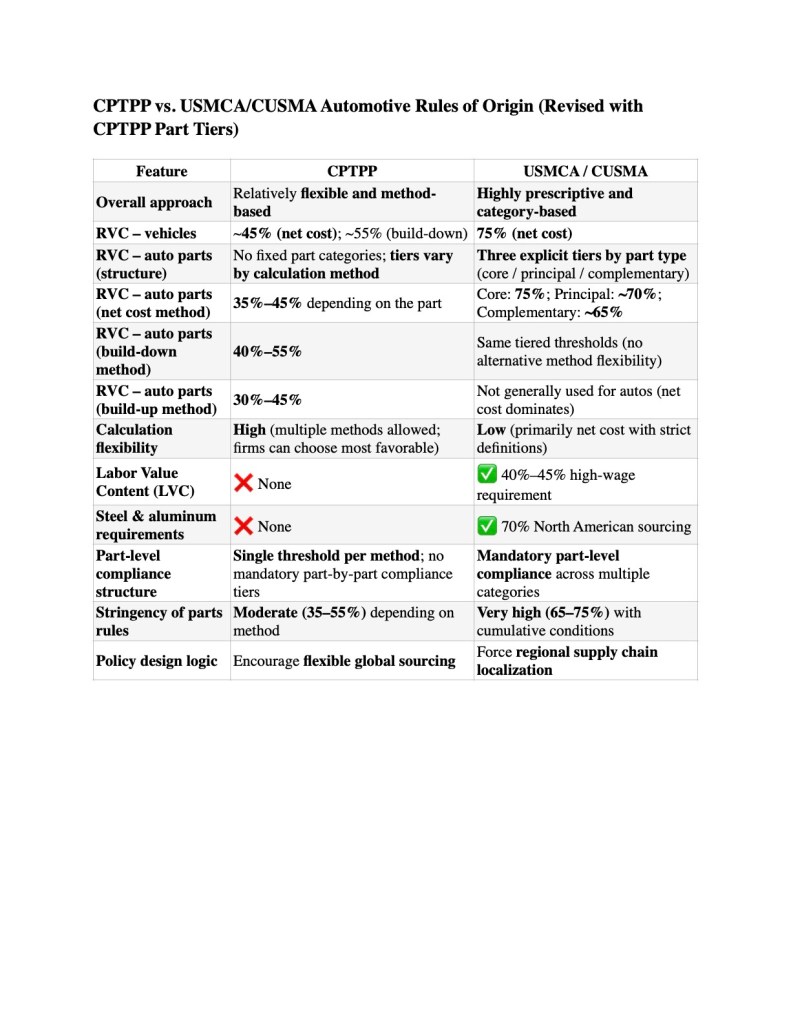
The difference in content requirements and overall flexibility between CPTPP and USMCA/CUSMA is obvious in this comparison. A 45% regional value content (RVC) rule with no thresholds for steel and aluminum, core parts or labour value offers a massive flexibility boost over the USMCA/CUSMA with its regional sourcing requirements, 75% RVC test and core parts provisions covering key components such as batteries. On that basis alone, vehicles built in Mexico pursuant to CPTPP rules will be able to radically underprice competing products made in any of the North American jurisdictions pursuant to USMCA/CUSMA rules. But is there an even more insidious element to this approach to automotive trade?
The RVC rule under the CPTPP applies to all content sourced from CPTPP member states. Those include Mexico and Canada but also Vietnam and Malaysia, where Chinese manufacturers either have or are in the process of establishing manufacturing including battery production. Chinese steel and aluminum shipped to either of those countries and transformed into auto parts might pass the auto parts RVC test of the CPTPP (a fairly simple exercise of tariff engineering) and, having done so, the entire value of the part would be CPTPP qualifying under the roll up rules of the deal. In other words, the RVC rule of CPTPP does not consider the true net value of manufacturing in the region so a 45% RVC test requires less actual local content. Operating through a third country rather than shipping parts directly to Mexico offers substantial advantages to Chinese manufacturers. For battery production, that might mean exporting cells to a CPTPP member country and assembling them with locally sourced cases, wiring and controllers to create a CPTPP qualifying product whose whole value would count toward CPTPP origin. That point of assembly could be Vietnam, Malaysia or Indonesia (once its accession to the CPTPP is complete) or it could be Canada but in all cases it would be a Trojan Horse for Chinese content.
Whether this scenario is good or bad depends on your point of view. Might it lead to more affordable vehicles for Canadian consumers? Certainly, but it will also imperil traditional supply chains in North America. So it could be good for consumers but be bad for jobs and investment. Either way, it requires active management and so far Ottawa appears to be asleep in the watch tower.
If the US, Mexico and Canada are serious about creating a vibrant North American economy with a fully functional manufacturing sector, particularly in strategic sectors, the three governments need to address some fundamental issues in the upcoming USMCA/CUSMA review. All three countries are stronger with a common market that fully engages both the power of our consumers and our raw material, energy and industrial strengths. If this becomes a zero sum game where one gains at the expense of the others, the free trade deal runs the risk of splintering with losses for all.
There are solutions to this problem and they could include greater flexibility in sourcing of intermediate parts and materials as well as a side letter between Canada and Mexico requiring any vehicle trade between them to meet USMCA rules of origin. However those are part of a longer list of considerations that I will address in a future post.
In the meantime, just be aware that Canada’s approach to trade policy is disjointed and vulnerable. Far from encouraging joint ventures with Chinese companies, federal policy has invited a takeover.


Leave a Reply